Tying off loose ends can be very satisfying. When the detective eventually reveals the crucial connection between facts that have been out in the open the whole time and is finally able to name the killer: amazing. That’s literally what suspense crime dramas are made for. Or, in my line of work, rarely is something so capable of turning a good day into a great one than fully understanding some otherwise inexplicable misbehaviour/failure/bug of the system you’re working on. It’s all about having all important puzzle pieces in sight and then connecting them in the right way. Here is one of those connections that I was only able to make years after having seen all the pieces — multiple times.
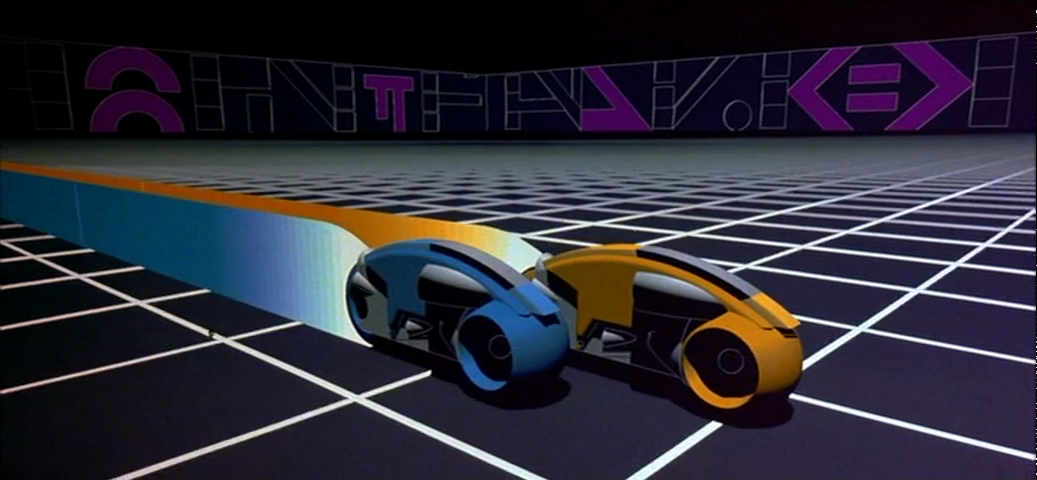
I am talking about the famous Disney film TRON. If you don’t know this movie I can only recommend to go and watch it. It is a milestone in film making and a great influence on how computers, cyberspace, “the net”, evil artificial intelligence, single-working genius developers, hacking, malicious computer mega companies, etc. are perceived by the general public.
When I watched this movie for the first time in the early 1990’s I watched the German dubbed version, of course. Back then, before private TV stations took over the lion’s share of TV attention, the German public broadcasting companies (ARD, ZDF, WDR, …) would regularly put on English movies that weren’t shown in cinemas anymore. And while English language is taught widely in secondary school in Germany, most Germans will prefer enjoying a film in a German translation. This dubbing is rather sophisticated and well done; even to the point where specific English—speaking Actors, say Robert De Niro, would always be dubbed by the same German Actor, so that the German viewers would recognise “his” voice across the different films.
Now, this translation to German language cannot be done on a word—by—word basis alone. The meaning and the subtext of whatever a film character says need to be carried over, too. This can be particularly tricky when the original dialog contains cultural references that make no sense to a German viewer. TRON contains such a reference and the solution that the translators found for the piece of dialog planted an idea about computers into the subconsciousness of all German viewers of that movie. The funny part is that this idea does not exist in the English movie at all.
The idea gets introduced during one of the “setup” scenes in the movie. Around fifteen minutes into the story, we have learned that there is the big evil AI, called MCP (Master Control Program), that runs gladiator type games where humanised programs compete against each other. Moreover, this MCP also communicates with the CEO of the large software company ENCOM, Edward Dillinger. This Ed Dillinger managed to climb the corporate ladder all the way up to the top job by stealing the programs for video games from another ENCOM programmer: Kevin Flynn — the hero in this film. There are also two other ENCOM employees, Karen, a physicist and the former girlfriend of Flynn and her current partner, Alan, also a computer programmer. The latter two learn that Flynn is trying to hack into the ENCOM mainframe computer to find proof for that he is the original author of the super-successful video games and decide to talk to him. Flynn is running a video arcade — and lives on the floor above it. That is where Karen and Alan visit him to put him on the spot.
It is in this scene — around 19 min 40 sec — when Flynn explains what happened in full length, Alan is a bit slow on the uptake.

Alan doesn’t get it
Flynn starts by saying (in the German version):
Ok, Sherman hat das Ausspeicherungsbelegsystem auf drei Jahre eingestellt.
Flynn, in the German version
In the original English version, the same line is:
Okay, Sherman, set the way-back machine for three years ago.
Flynn, in the English version

Flynn, explaining the whole story from the beginning for Alan. ‘Okay. Sherman, set the way-back machine for three years ago.’
Now, for the average American in 1982 when the film came out, this is a perfectly fine reference to a classic TV show called Peabody’s Improbably History. From what I gather, this show is about a boy Sherman, his super smart and talking dog Peabody and their time machine, which they call the Wayback Machine. The phrase “Okay, Sherman, set the way-back machine for three years ago” references Peabody, the dog, instructing Peabody, the boy, to set up travel back to the period in time relevant to whatever question they wanted to answer. This would have been easily understood by the American audience and accepted as a nice reference line, with no further impact on the film’s story.
For the German audience this would not work. Nobody in Germany has heard of the Peabody show. Nobody in Germany knows who the heck Sherman is or what a way-back machine is supposed to be. So the translators had to come up with something.
Whatever they would come up with, also would need to fit the time it took Flynn in the movie to say the English sentence; as the character is visible while speaking in this scene, there is very little wiggle room for the translation.
The translation they used got rid of the unknown way-back machine and replaced it with the German chain-word (Nominalkompositum) Auspeicherunsgbelegsystem.
Chainwords are a neat trick of the German language: one can make up new nouns by chaining existing ones. Even neater is that the meaning of this noun-chain can typically be derived by combining the meanings of the nouns that make up the chain. That way, people can understand your made-up words without having to explain them in all that much detail beforehand. For Ausspeicherungsbelegsystem, a word that otherwise does not exist in German, the meaning would be something like: a system that produces and keeps proofs of memory outputs. A possible association here can be that this system keeps track on who printed out a file from the mainframe. Another one could be that this system keeps track on who, when, how a file from the mainframe was copied/moved/deleted etc. Squint a little and what this German word invention describes is an audit trail function.
What a nice piece of translation art: not only does the German version nearly completely circumvent the cultural reference that the German audience wouldn’t be able to resolve, but it also introduces a potential solution to the main characters problem: proving who stole his games and that he was the original author.
In the remainder of the film, this device is of course never mentioned again, as it has never been part of the actual story. In fact, there is a scene where the baddy CEO discusses how the MCP might go about hiding the programs - with the MCP. So even the evil AI doesn’t know about any audit trail systems in its own mainframe.
For me, a German viewer, having this system mentioned neatly laid out the goal of the hero’s quest and left me with the impression that all professional, powerful computers would definitely have an Auspeicherungsbelegsystem. And at that age, I didn’t get too distracted by the mentioning of “Sherman” a character that had not been introduced in the movie and, in fact, never shows up at all :)
Years after watching the film for the first time, I eventually watched it in the English original version and was disappointed not to learn what the proper term for Auspeicherungsbelegsystem is in English. This led me to search for the movie script online and to writing this post — after I managed to tie this loose end.